Advantages Of Rs232 Serial Communication
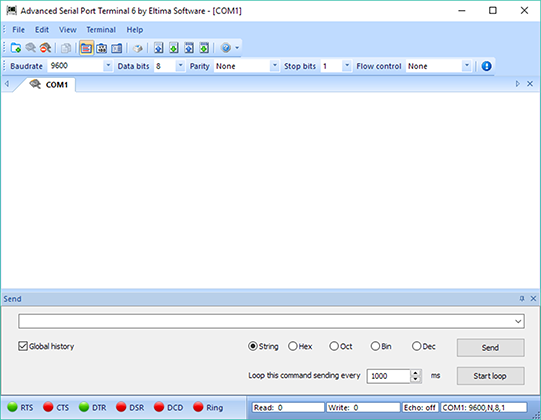
Nov 23, 2010. One of the tools we use most when debugging our projects is serial input/output. Serial is very easy to implement, and it allows you to send/receive any data you need from your microcontroller to a computer's serial port so it can be viewed using a terminal emulator. These two devices are compatible from a.
Serial data is still being sent today, one bit at a time, just as it has always been for over 50 years. While serial ports may not be as prevalent on new PCs these days, serial is still in use everywhere. The new PC standard USB has more software overhead and requires more advanced processors to implement, so serial will live on! RS-232 RS-232 can support data rates of up to 920 kbps (normally 9600 and 115.2K are the maximum rates) and is commonly found in 9 or 25 pin configurations, however only three pins are required.
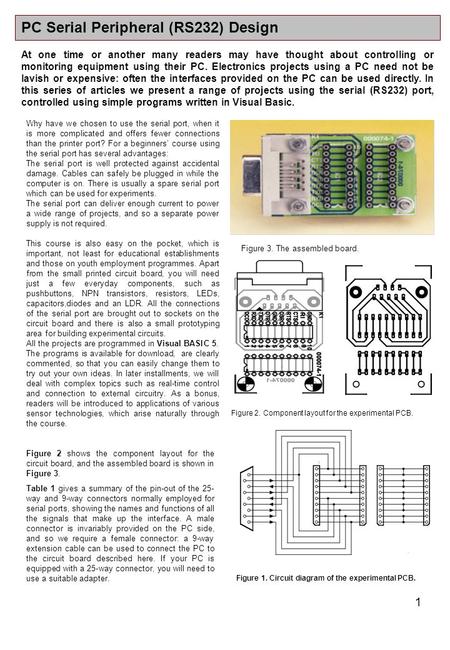
Most applications drop many of the less commonly used pins, though some configurations such as a data modem connect every pin for full handshaking capabilities. An RS-232 is a point to point connection made between a Data Terminal Equipment (DTE) device and a Data Communications Equipment (DCE) device. RS-232 has a maximum cable length of 50 Ft at 9600 baud. This limitation can be overcome by transmitting serial data over another medium. RS-232 ports/cables can be found in factory automation and metering, medical equipment, consumer products, and many other devices. Advantages of RS-232: • Simple wiring and connectors • Widely available • Low cost • Most embedded processor include this interface • Software to implement a serial port is easy Disadvantages of RS-232: • Incompatibilities in wiring and configuration between devices • Short cable lengths • Subject to noise interference • Low data rates • Many different software protocols RS-422 RS-422 offers one of the fastest serial data rates at 10Mbps. RS-422 is a multi-drop configuration, allowing for up to 10 unit loads.
Its use of voltage differences makes it ideal for noisy environments. RS-422 can support cable lengths of up to 4000 feet, however its data rate lessens as distance increases. Advantages of RS-422: • High data rates • Less subject to noise • Longer cable lengths Disadvantages of RS-422: • Not as commonly used • Unidirectional • For most applications, only one transmitter is used RS-485 RS-485 provides similar speed advantages as RS-422, allowing for data rates up to 10Mbps. It differs in that it is a multipoint configuration, allowing for support of multiple drivers and multiple receivers.
RS-485 can support up to 32 unit loads due to its bi-directional interface. Advantages of RS-485 • Low cost • Immune to noise • Multipoint applications • Operates on a single pair of wires Disadvantages of RS-485 • Not as commonly used • Less standardized connectors and terminology • Half-duplex master-slave operation Grid Connect’s Engineering Staff offers deep technical knowledge in all things serial. In addition to offering a wide selection of, we can also provide to meet your every need..
Coming in future posts in this series on serial we will discuss Serial to Ethernet, Other Serial Transport Methods, RTS/CTS, Null Modems, Gender Changers, Loopback and more!
A connector as described in the RS-232 standard In, RS-232, 232 is a introduced in 1960 for transmission of data. It formally defines the signals connecting between a DTE ( ) such as a, and a DCE ( or ), such as a. The RS-232 standard had been commonly used in. The standard defines the electrical characteristics and timing of signals, the meaning of signals, and the physical size and of connectors. The current version of the standard is TIA-232-F Interface Between Data Terminal Equipment and Data Circuit-Terminating Equipment Employing Serial Binary Data Interchange, issued in 1997. An RS-232 serial port was once a standard feature of a, used for connections to,,, data storage,, and other peripheral devices.
However, RS-232, when compared to other serial interfaces such as RS-422, RS-485 and, is hampered by low transmission speed, short maximum cable length, large voltage swing, large standard connectors, no multipoint capability and limited multidrop capability. In modern personal computers, has displaced RS-232 from most of its peripheral interface roles. Many computers no longer come equipped with RS-232 ports (although some come equipped with a COM port header that allows the user to install a bracket with a DE-9 port) and must use either an external USB-to-RS-232 converter or an internal expansion card with one or more serial ports to connect to RS-232 peripherals. Nevertheless, thanks to their simplicity and past ubiquity, RS-232 interfaces are still used—particularly in industrial machines, networking equipment, and scientific instruments where a short-range, point-to-point, low-speed wired data connection is adequate. Contents • • • • • • • • • • • • • • • • • • • • • • • Scope of the standard [ ] The (EIA) standard RS-232-C as of 1969 defines: • Electrical signal characteristics such as voltage levels,, timing, and of signals, voltage withstand level, behavior, and maximum load.
• Interface mechanical characteristics, pluggable connectors and pin identification. • Functions of each circuit in the interface connector. • Standard subsets of interface circuits for selected telecom applications. The standard does not define such elements as the (i.e.,, or others), the framing of characters (start or stop bits, etc.), transmission order of bits, or error detection protocols.
The character format and transmission bit rate are set by the serial port hardware which may also contain circuits to convert the internal to RS-232 compatible signal levels. The standard does not define bit rates for transmission, except that it says it is intended for lower than 20,000 bits per second. History [ ] RS-232 was first introduced in 1960 by the (EIA) as a Recommended Standard.
The original DTEs were electromechanical, and the original DCEs were (usually) modems. When (smart and dumb) began to be used, they were often designed to be interchangeable with teletypewriters, and so supported RS-232.
The C revision of the standard was issued in 1969 in part to accommodate the electrical characteristics of these devices. [ ] Because the standard did not foresee the requirements of devices such as computers, printers, test instruments,, and so on, designers implementing an RS-232 compatible interface on their equipment often interpreted the standard idiosyncratically. The resulting common problems were non-standard pin assignment of circuits on connectors, and incorrect or missing control signals.
The lack of adherence to the standards produced a thriving industry of, patch boxes, test equipment, books, and other aids for the connection of disparate equipment. A common deviation from the standard was to drive the signals at a reduced voltage. Some manufacturers therefore built transmitters that supplied +5 V and −5 V and labeled them as 'RS-232 compatible'. [ ] Later personal computers (and other devices) started to make use of the standard so that they could connect to existing equipment.
For many years, an RS-232-compatible port was a standard feature for, such as modem connections, on many computers (with the computer acting as the DTE). It remained in widespread use into the late 1990s. In personal computer peripherals, it has largely been supplanted by other interface standards, such as USB. RS-232 is still used to connect older designs of peripherals, industrial equipment (such as ), ports, and special purpose equipment.
The standard has been renamed several times during its history as the sponsoring organization changed its name, and has been variously known as EIA RS-232, EIA 232, and, most recently as TIA 232. The standard continued to be revised and updated by the and since 1988 by the (TIA). Revision C was issued in a document dated August 1969. Revision D was issued in 1986. The current revision is TIA-232-F Interface Between Data Terminal Equipment and Data Circuit-Terminating Equipment Employing Serial Binary Data Interchange, issued in 1997. Changes since Revision C have been in timing and details intended to improve harmonization with the standard V.24, but equipment built to the current standard will interoperate with older versions.
[ ] Related standards include V.24 (circuit identification) and V.28 (signal voltage and timing characteristics). [ ] In revision D of EIA-232, the D-subminiature connector was formally included as part of the standard (it was only referenced in the appendix of RS-232-C). The voltage range was extended to ±25 volts, and the circuit capacitance limit was expressly stated as 2500 pF. Revision E of EIA-232 introduced a new, smaller, standard D-shell 26-pin 'Alt A' connector, and made other changes to improve compatibility with CCITT standards V.24, V.28 and ISO 2110. Main article: In the book Hardware Design Guide, deprecated support for the RS-232 compatible serial port of the original IBM PC design. Today, RS-232 has mostly been replaced in personal computers by for local communications.
Advantages compared to RS-232 are that USB is faster, uses lower voltages, and has connectors that are simpler to connect and use. Disadvantages of USB compared to RS-232 are that USB is far less immune to EMI and that maximum cable length is much shorter (15 meters for RS-232 v.s. 3 - 5 meters for USB depending on USB speed used). [ ] In fields such as laboratory automation or surveying, RS-232 devices may continue to be used.,,, and are programmable via RS-232. Some manufacturers have responded to this demand by re-introducing the connector on their computers. RS-232 ports are also commonly used to communicate to such as, where no monitor or keyboard is installed, during boot when is not running yet and therefore no network connection is possible.
A computer with an RS-232 serial port can communicate with the serial port of an (such as a ) as an alternative to monitoring over Ethernet. Physical interface [ ] In RS-232, user data is sent as a of. Both synchronous and asynchronous transmissions are supported by the standard. In addition to the data circuits, the standard defines a number of control circuits used to manage the connection between the DTE and DCE. Each data or control circuit only operates in one direction, that is, signaling from a DTE to the attached DCE or the reverse. Because transmit data and receive data are separate circuits, the interface can operate in a manner, supporting concurrent data flow in both directions.
The standard does not define character framing within the data stream, or character encoding. Voltage levels [ ]. RS-232 data line on the terminals of the receiver side (RxD) probed by an oscilloscope (for an ASCII 'K' character (0x4B) with 1 start bit, 8 data bits, 1 stop bit, and no parity bits). The RS-232 standard defines the voltage levels that correspond to logical one and logical zero levels for the data transmission and the control signal lines.
Valid signals are either in the range of +3 to +15 volts or the range −3 to −15 volts with respect to the 'Common Ground' (GND) pin; consequently, the range between −3 to +3 volts is not a valid RS-232 level. For data transmission lines (TxD, RxD, and their secondary channel equivalents), logic one is defined as a negative voltage, the signal condition is called 'mark'. Logic zero is positive and the signal condition is termed 'space'. Control signals have the opposite polarity: the asserted or active state is positive voltage and the deasserted or inactive state is negative voltage. Examples of control lines include request to send (RTS), clear to send (CTS), (DTR), and data set ready (DSR). RS-232 logic and voltage levels Data circuits Control circuits Voltage 0 (space) Asserted +3 to +15 V 1 (mark) Deasserted −15 to −3 V The standard specifies a maximum open-circuit voltage of 25 volts: signal levels of ±5 V, ±10 V, ±12 V, and ±15 V are all commonly seen depending on the voltages available to the line driver circuit.
Some RS-232 driver chips have inbuilt circuitry to produce the required voltages from a 3 or 5 volt supply. Iso Container Corner Castings Houston. RS-232 drivers and receivers must be able to withstand indefinite short circuit to ground or to any voltage level up to ±25 volts. The, or how fast the signal changes between levels, is also controlled. Because the voltage levels are higher than logic levels typically used by integrated circuits, special intervening driver circuits are required to translate logic levels.
These also protect the device's internal circuitry from short circuits or transients that may appear on the RS-232 interface, and provide sufficient current to comply with the slew rate requirements for data transmission. Because both ends of the RS-232 circuit depend on the ground pin being zero volts, problems will occur when connecting machinery and computers where the voltage between the ground pin on one end, and the ground pin on the other is not zero. This may also cause a hazardous. Use of a common ground limits RS-232 to applications with relatively short cables. If the two devices are far enough apart or on separate power systems, the local ground connections at either end of the cable will have differing voltages; this difference will reduce the noise margin of the signals. Balanced, differential serial connections such as,, and USB can tolerate larger ground voltage differences because of the differential signaling.
Unused interface signals terminated to ground will have an undefined logic state. Where it is necessary to permanently set a control signal to a defined state, it must be connected to a voltage source that asserts the logic 1 or logic 0 level, for example with a pullup resistor. Some devices provide test voltages on their interface connectors for this purpose. Connectors [ ] RS-232 devices may be classified as Data Terminal Equipment (DTE) or Data Circuit-terminating Equipment (DCE); this defines at each device which wires will be sending and receiving each signal. According to the standard, male connectors have DTE pin functions, and female connectors have DCE pin functions.
Other devices may have any combination of connector gender and pin definitions. Many terminals were manufactured with female connectors but were sold with a cable with male connectors at each end; the terminal with its cable satisfied the recommendations in the standard. The standard recommends the 25-pin connector up to revision C, and makes it mandatory as of revision D. Most devices only implement a few of the twenty signals specified in the standard, so connectors and cables with fewer pins are sufficient for most connections, more compact, and less expensive. Personal computer manufacturers replaced the connector with the smaller connector. This connector, with a different pinout (see ), is prevalent for personal computers and associated devices.
Presence of a 25-pin D-sub connector does not necessarily indicate an RS-232-C compliant interface. For example, on the original IBM PC, a male D-sub was an RS-232-C DTE port (with a non-standard interface on reserved pins), but the female D-sub connector on the same PC model was used for the. Some personal computers put non-standard voltages or signals on some pins of their serial ports.
Main article: The standard does not define a maximum cable length, but instead defines the maximum capacitance that a compliant drive circuit must tolerate. A widely used rule of thumb indicates that cables more than 15 m (50 ft) long will have too much capacitance, unless special cables are used. By using low-capacitance cables, communication can be maintained over larger distances up to about 300 m (1,000 ft).
For longer distances, other signal standards are better suited to maintain high speed. Since the standard definitions are not always correctly applied, it is often necessary to consult documentation, test connections with a, or use trial and error to find a cable that works when interconnecting two devices.
Connecting a fully standard-compliant DCE device and DTE device would use a cable that connects identical pin numbers in each connector (a so-called 'straight cable'). ' are available to solve gender mismatches between cables and connectors. Connecting devices with different types of connectors requires a cable that connects the corresponding pins according to the table below.
Cables with 9 pins on one end and 25 on the other are common. Manufacturers of equipment with connectors usually provide a cable with either a DB-25 or DE-9 connector (or sometimes interchangeable connectors so they can work with multiple devices). Poor-quality cables can cause false signals by between data and control lines (such as ).
If a given cable will not allow a data connection, especially if a is in use, a cable may be necessary. Gender changers and null modem cables are not mentioned in the standard, so there is no officially sanctioned design for them. 3-wire and 5-wire RS-232 [ ] A minimal '3-wire' RS-232 connection consisting only of transmit data, receive data, and ground, is commonly used when the full facilities of RS-232 are not required. Even a two-wire connection (data and ground) can be used if the data flow is one way (for example, a digital postal scale that periodically sends a weight reading, or a GPS receiver that periodically sends position, if no configuration via RS-232 is necessary). When only hardware flow control is required in addition to two-way data, the RTS and CTS lines are added in a 5-wire version.
Data and control signals [ ] The following table lists commonly used RS-232 signals (called 'circuits' in the specifications) and their pin assignments on the recommended DB-25 connectors. (See ) for other commonly used connectors not defined by the standard.) Circuit Direction pin Name Typical purpose Abbreviation DTE DCE DTE is ready to receive, initiate, or continue a call.
DTR out in 20 DCE is receiving a carrier from a remote DCE. DCD in out 8 Data Set Ready DCE is ready to receive and send data. DSR in out 6 Ring Indicator DCE has detected an incoming ring signal on the telephone line. RI in out 22 Request To Send DTE requests the DCE prepare to transmit data.
RTS out in 4 Ready To Receive DTE is ready to receive data from DCE. If in use, RTS is assumed to be always asserted. RTR out in 4 Clear To Send DCE is ready to accept data from the DTE. CTS in out 5 Transmitted Data Carries data from DTE to DCE. TxD out in 2 Received Data Carries data from DCE to DTE. RxD in out 3 Common Ground Zero voltage reference for all of the above.
GND common 7 Protective Ground Connected to chassis ground. PG common 1 The signals are named from the standpoint of the DTE.
For the other connections, and establishes the 'zero' voltage to which voltages on the other pins are referenced. The DB-25 connector includes a second 'protective ground' on pin 1; this is connected internally to equipment frame ground, and should not be connected in the cable or connector to signal ground. Ring Indicator [ ] Ring Indicator (RI) is a signal sent from the DCE to the DTE device. It indicates to the terminal device that the phone line is ringing.
In many computer serial ports, a is generated when the RI signal changes state. Having support for this hardware interrupt means that a program or operating system can be informed of a change in state of the RI pin, without requiring the software to constantly 'poll' the state of the pin. RI does not correspond to another signal that carries similar information the opposite way. On an external modem the status of the Ring Indicator pin is often coupled to the 'AA' (auto answer) light, which flashes if the RI signal has detected a ring. The asserted RI signal follows the ringing pattern closely, which can permit software to detect patterns.
The Ring Indicator signal is used by some older (UPSs) to signal a power failure state to the computer. Certain personal computers can be configured for, allowing a computer that is suspended to answer a phone call. RTS, CTS, and RTR [ ]. Further information: The RTS and CTS signals were originally defined for use with half-duplex (one direction at a time) modems such as the. These modems disable their transmitters when not required and must transmit a synchronization preamble to the receiver when they are re-enabled. The DTE asserts RTS to indicate a desire to transmit to the DCE, and in response the DCE asserts CTS to grant permission, once synchronization with the DCE at the far end is achieved. Such modems are no longer in common use.
There is no corresponding signal that the DTE could use to temporarily halt incoming data from the DCE. Thus RS-232's use of the RTS and CTS signals, per the older versions of the standard, is asymmetric. This scheme is also employed in present-day RS-232 to converters. RS-485 is a multiple-access bus on which only one device can transmit at a time, a concept that is not provided for in RS-232. The RS-232 device asserts RTS to tell the converter to take control of the RS-485 bus so that the converter, and thus the RS-232 device, can send data onto the bus. Modern communications environments use full-duplex (both directions simultaneously) modems.
In that environment, DTEs have no reason to deassert RTS. However, due to the possibility of changing line quality, delays in processing of data, etc., there is a need for symmetric, bidirectional. A symmetric alternative providing flow control in both directions was developed and marketed in the late 1980s by various equipment manufacturers. It redefined the RTS signal to mean that the DTE is ready to receive data from the DCE.
This scheme was eventually codified in version RS-232-E (actually TIA-232-E by that time) by defining a new signal, 'RTR (Ready to Receive)', which is CCITT V.24 circuit 133. TIA-232-E and the corresponding international standards were updated to show that circuit 133, when implemented, shares the same pin as RTS (Request to Send), and that when 133 is in use, RTS is assumed by the DCE to be asserted at all times. In this scheme, commonly called 'RTS/CTS flow control' or 'RTS/CTS handshaking' (though the technically correct name would be 'RTR/CTS'), the DTE asserts RTR whenever it is ready to receive data from the DCE, and the DCE asserts CTS whenever it is ready to receive data from the DTE. Unlike the original use of RTS and CTS with half-duplex modems, these two signals operate independently from one another. This is an example of.
However, 'hardware flow control' in the description of the options available on an RS-232-equipped device does not always mean RTS/CTS handshaking. Equipment using this protocol must be prepared to buffer some extra data, since the remote system may have begun transmitting just before the local system deasserts RTR. Seldom-used features [ ] The EIA-232 standard specifies connections for several features that are not used in most implementations. Their use requires 25-pin connectors and cables. Signal rate selection [ ] The DTE or DCE can specify use of a 'high' or 'low' signaling rate. The rates, as well as which device will select the rate, must be configured in both the DTE and DCE.
The prearranged device selects the high rate by setting pin 23 to ON. Loopback testing [ ] Many DCE devices have a capability used for testing. When enabled, signals are echoed back to the sender rather than being sent on to the receiver.
If supported, the DTE can signal the local DCE (the one it is connected to) to enter loopback mode by setting pin 18 to ON, or the remote DCE (the one the local DCE is connected to) to enter loopback mode by setting pin 21 to ON. The latter tests the communications link, as well as both DCEs. When the DCE is in test mode, it signals the DTE by setting pin 25 to ON.
A commonly used version of loopback testing does not involve any special capability of either end. A hardware loopback is simply a wire connecting complementary pins together in the same connector (see ). Loopback testing is often performed with a specialized DTE called a (or BERT). Timing signals [ ] Some synchronous devices provide a to synchronize data transmission, especially at higher data rates. Two timing signals are provided by the DCE on pins 15 and 17.
Pin 15 is the transmitter clock, or send timing (ST); the DTE puts the next bit on the data line (pin 2) when this clock transitions from OFF to ON (so it is stable during the ON to OFF transition when the DCE registers the bit). Pin 17 is the receiver clock, or receive timing (RT); the DTE reads the next bit from the data line (pin 3) when this clock transitions from ON to OFF. Alternatively, the DTE can provide a clock signal, called transmitter timing (TT), on pin 24 for transmitted data. Data is changed when the clock transitions from OFF to ON, and read during the ON to OFF transition. TT can be used to overcome the issue where ST must traverse a cable of unknown length and delay, clock a bit out of the DTE after another unknown delay, and return it to the DCE over the same unknown cable delay.
Since the relation between the transmitted bit and TT can be fixed in the DTE design, and since both signals traverse the same cable length, using TT eliminates the issue. Fender American Deluxe Strat Hss Manual Muscle. TT may be generated by looping ST back with an appropriate phase change to align it with the transmitted data. ST loop back to TT lets the DTE use the DCE as the frequency reference, and correct the clock to data timing. Synchronous clocking is required for such protocols as,, and.
Secondary channel [ ] A secondary data channel, identical in capability to the primary channel, can optionally be implemented by the DTE and DCE devices. Pin assignments are as follows: Signal Pin Common Ground 7 (same as primary) Secondary Transmitted Data (STD) 14 Secondary Received Data (SRD) 16 Secondary Request To Send (SRTS) 19 Secondary Clear To Send (SCTS) 13 Secondary Carrier Detect (SDCD) 12 Related standards [ ] Other serial signaling standards may not interoperate with standard-compliant RS-232 ports. For example, using the of near +5 and 0 V puts the mark level in the undefined area of the standard. Such levels are sometimes used with -compliant receivers and.
A 20 mA uses the absence of 20 mA current for high, and the presence of current in the loop for low; this signaling method is often used for long-distance and links. Connection of a current-loop device to a compliant RS-232 port requires a level translator.
Current-loop devices can supply voltages in excess of the withstand voltage limits of a compliant device. The original IBM PC serial port card implemented a 20 mA current-loop interface, which was never emulated by other suppliers of equipment.