Skyrim Modern Crossbow Download
The Elder Scrolls V: Skyrim Director(s) Craig Lafferty Ashley Cheng Kurt Kuhlmann Guy Carver Matthew Carofano Emil Pagliarulo Series,,,,, Release Windows, PlayStation 3, Xbox 360 • WW: November 11, 2011 PlayStation 4, Xbox One • WW: October 28, 2016 Nintendo Switch, PlayStation VR • WW: November 17, 2017 Mode(s) The Elder Scrolls V: Skyrim is an developed by and published. It is the fifth main installment in series, following, and was released worldwide for, and on November 11, 2011. The game's main story revolves around the and their quest to defeat Alduin the World-Eater, a dragon who is prophesied to destroy the world. The game is set two hundred years after the events of Oblivion, and takes place in the fictional province of Skyrim. Over the course of the game, the player completes quests and develops the character by improving skills.
The game continues the open world tradition of its predecessors by allowing the player to travel anywhere in the game world at any time, and to ignore or postpone the main storyline indefinitely. Skyrim was developed using the, rebuilt specifically for the game.
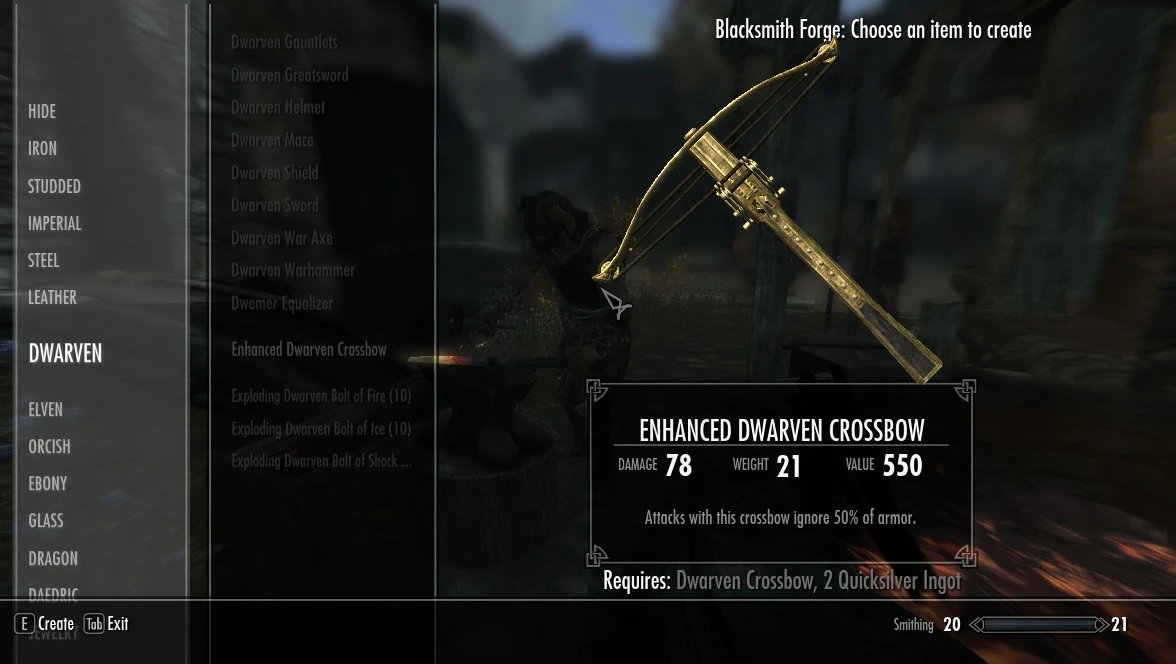
Only thing I know of is a flintlock pistol that fires soul gems (last I checked anyways) Thats all I know about that particular mod because I've never downloaded it or played with it, merely read about it. Anything more then that you are probably out of luck. There is an effort to make the crossbow automatic if that. There is a credits article which lists all of the mods added here please see it for a list of what you would want to remove from your load order.
The team opted for a unique and more diverse game world than Oblivion 's Imperial Province of Cyrodiil, which game director and executive producer considered less interesting by comparison. The game was released to critical acclaim, with reviewers particularly mentioning the character development and setting, and is considered to be. However, it nonetheless received some criticism, particularly for its numerous technical issues present at launch. The game shipped over seven million copies to retailers within the first week of its release, and sold over 30 million copies across all platforms. Stellar Outlook Pst To Mbox Converter Key. Three (DLC) were released—, and —which were repackaged into The Elder Scrolls V: Skyrim – Legendary Edition, which was released in June 2013. The Elder Scrolls V: Skyrim – Special Edition, a remastered version of the game, was released for Windows, and in October 2016, which includes all three DLC expansions and a graphical upgrade, along with additional features such as capabilities on consoles. Versions for the and were released on November 17, 2017.
See also: The Elder Scrolls V: Skyrim is an, playable from either a. The player may freely roam over the land of Skyrim, which is an environment consisting of wilderness expanses, dungeons, cities, towns, fortresses and villages. Players may navigate the game world more quickly by riding horses, or by utilizing a fast-travel system which allows them to warp to previously discovered locations. The game's main quest can be completed or ignored at the player's preference after the first stage of the quest is finished. However, some quests rely on the main storyline being at least partially completed. (NPCs) populate the world and can be interacted with in a number of ways; the player may engage them in conversation, marry an eligible NPC, kill them, or engage in a nonlethal 'brawl'.
As in previous The Elder Scrolls games, killing certain NPCs can make some quests or items unobtainable. Some NPCs cannot be killed due to their importance in later storylines. If witnessed, crimes like murder and theft accrue the player a bounty, which is tracked independently in each of Skyrim's nine holds. Should the player be stopped by a guard, they may wipe their bounty with gold or jail time, or may resist arrest which will trigger an aggressive pursuit. NPCs may offer the player additional side-quests, and some side-quests have parameters adjusted based on nearby dungeons which the player has yet to explore. Some NPCs who are befriended or hired by the player may act as companions, who will accompany the player and aid them in combat.
The player may choose to join factions, which are organized groups of NPCs—for example, the Dark Brotherhood, a band of assassins. Each of the factions has an associated quest path to progress through. Each city and town in the game world has jobs that the player can engage in, such as farming.
The player's character engages in combat with monsters while exploring a dungeon. The player may dual-wield weapons and magic at once in order to be more effective against enemies. Players have the option to develop their character. At the beginning of the game, players create their character by selecting their sex and choosing between one of several races, including humans, orcs, and cat or lizard-like creatures, and then customizing their character's appearance. Over the course of the game, players improve their character's skills, which are numerical representations of their ability in certain areas.
There are eighteen skills divided evenly among the three schools of combat, magic, and stealth. When players have trained skills enough to meet the required, their character levels up. Each time their character levels, the players may choose to select a skill-specific ability called a perk, or store perk points for later use. Earlier entries in The Elder Scrolls series used a system to determine which skills would contribute to the character's leveling, but Skyrim allows players to discover preferred skills as they play the game and rewards them with more experience when a frequently used skill is leveled. A (HUD) appears when any of the player's three main attributes (health, magicka, and stamina) are being depleted. Attributes regenerate over time, although this process can be accelerated by using potions or regenerative spells.
Health is depleted primarily when the player takes damage, and the loss of all health results in death. Magicka is depleted by the use of spells, certain poisons, and by being struck by lightning-based attacks. Stamina determines the player's effectiveness in combat and is depleted by sprinting, performing heavy 'power attacks', and being struck by frost-based attacks. The player's inventory can be accessed from the menu and items can be viewed in 3D, which may prove essential in solving puzzles found in dungeons. The player's effectiveness in combat relies on the use of weapons and armor (which may be bought, found, or forged), and on the use of magic spells, which may be bought or unlocked by finding spell tomes.
Weapons and magic are assigned to each hand, allowing for, and can be swapped out through a quick-access menu of favorite items. Some weapons and master spells require both hands. Shields can be used to fend off enemy attacks and reduce incurred damage, or offensively through bashing attacks.
Blunt, bladed and hacking weapons can be used in close combat and each have specific advantages and roles. For example, the player can perform power attacks with each weapon. Spells have several functions, such as regenerating the player's health, attacking enemies, confusing people or creatures, temporarily raising the dead, casting light, or turning iron into silver. A may be utilized in long-range combat, but the bow can also be used as a defensive melee weapon in close combat, by 'bashing'. The player can enter sneak mode and pickpocket, or deliver powerful sneak attacks to unsuspecting enemies. When exploring the game world, the player may encounter wildlife.
Many creatures in the wilderness are immediately hostile towards the player. However, game animals such as elk and deer will simply run away. Skyrim is the first entry in The Elder Scrolls to include in the game's wilderness. Like other creatures, dragons are generated randomly in the world and will engage in combat with NPCs, creatures, and the player. Some dragons may attack cities and towns when in their proximity.
The player character can absorb the souls of dragons in order to use powerful spells called 'dragon shouts', or 'Thu'um'. Each shout contains three words in the language spoken by dragons, and the strength of the shout will vary depending on how many words have been spoken. The words to shouts can be learned by visiting 'word walls' in dungeons or around the wilderness. The words to each shout are unlocked for use by spending the absorbed souls of slain dragons.
A regeneration period limits the player's use of shouts in gameplay. Synopsis Setting and characters Skyrim is set around 200 years after the events of The Elder Scrolls IV: Oblivion, although it is not a direct sequel. The game takes place in Skyrim, a province of the Empire on the continent of Tamriel, amid a civil war between two factions: the Stormcloaks and the Imperial Legion. The player character is a Dragonborn, a mortal born with the soul and power of a dragon. Alduin, a large black dragon who returns to the land after being lost in time, serves as the game's primary antagonist.
Alduin is the first dragon created by Akatosh, and is to destroy man and consume the world. Plot The player character is a prisoner being led to an Imperial execution in Helgen. Alduin unexpectedly interrupts the procession, destroying the town before the player can be executed. The player escapes in the chaos and journeys to the city of Whiterun to request aid against the dragon threat.
After slaying a different dragon that attacks nearby, the player absorbs the dragon's soul which grants them the ability to perform a shout. The city's guards inform the player that they must be Dragonborn. The player is summoned to meet with the Greybeards, an order of monks who live in seclusion.
The Greybeards train the player in using shouts and inform the player of their role in stopping Alduin. The player learns that Skyrim's civil war is the last in a sequence of prophetic events foretold by, which also predicted the return of Alduin. The player later meets with members of the Blades, an order of dragon hunters. The player and the Blades travel to Alduin's Wall, a prophetic engravement, to learn that ancient Nords used a special shout against Alduin so they could engage him. To gain more information, the player meets the ancient dragon Paarthurnax, the leader of the Greybeards.
Paarthurnax reveals that Alduin was cast into the currents of time by the use of an Elder Scroll in the hope that he would never reemerge. The player locates the Elder Scroll and uses it to peer through a window in time and learn the shout to combat Alduin. The player battles with Alduin, who then flees to Sovngarde, the Nordic afterlife, to gain strength by devouring the souls of deceased Nords. The player summons and traps a dragon named Odahviing, and learns from him that Alduin has fled to Sovngarde through a portal located at an ancient fort called Skuldafn. Odahviing agrees to fly the player to Skuldafn, claiming Alduin has shown himself as weak and undeserving of leadership over the dragon race by fleeing from the Dragonborn. The player enters Sovngarde and travels to the Hall of Valor.
There, they meet up with the three heroes of Nordic legend who defeated Alduin originally. With their help, the player defeats Alduin once and for all. Development Having completed work on Oblivion in 2006, began work on. It was during this time that the team began planning their next The Elder Scrolls game. From the outset, they had decided to set the new entry in the land of Skyrim, incorporating dragons into the main theme of the game.
Full development begun following the release of Fallout 3 in 2008; the developers considered Skyrim a to both Fallout 3 and previous games. The game was developed by a team of roughly 100 people composed of new talent as well as of the series' veterans. The production was supervised by, who was the director of several titles released by Bethesda Softworks. Design The team set the game in the province of Skyrim, designing it by hand. While similar in size to Oblivion's game world of Cyrodiil, the mountainous topography of the world inflates the game space and makes it more difficult to traverse than Cyrodiil, which was relatively flat.
In designing Skyrim's world, the team opted for a different approach to what was taken with Oblivion; art director Matt Carofano considered the 'epic-realism' of Skyrim's world design as a departure from Oblivion's generic representation of classic European fantasy lore. Howard expressed the team's desire to re-encapsulate the 'wonder of discovery' of 's game world in Skyrim, as the return to the classic fantasy of and in Oblivion meant sacrificing a world with a unique culture. As a way of creating diversity in the world, the team divided the world into nine sectors, known as holds, and attempted to make each hold feel topographically unique from another; in addition, the team wanted to reflect the socioeconomic background of the NPCs by making some locations elaborate and wealthy while others are poorer and lower-tech. Within Skyrim's universe is the use of 'dragon language'. The alphabet was constructed to look aesthetically dragon-like, hence the use of claw-like markings. The team sought to make each of the game's ten races feel unique; Howard considered the player's choice of race at the beginning of the game a more important decision than it had been in previous The Elder Scrolls games because the culture of Skyrim's world contains more racism. However, he reiterated that the player's choice of race does not have major game-affecting consequences as it simply adds 'flavor' in different NPCs' dispositions towards the player, and is not meant as a way of locking players out of particular quests.
Efforts to make Skyrim's world feel hand-crafted extended to the team abandoning the use of generated landscapes as they had done in Oblivion. While just one team member was charged with designing dungeons in Oblivion, Skyrim's 150 dungeons were designed by a group of eight people. Skyrim features 244 quests, over 300 points of interest with a mapmarker and numerous unmarked locations. Engine Skyrim is powered by Bethesda's Creation Engine, created specifically for Skyrim.
After Fallout 3's release, the team devised numerous design objectives to meet for Skyrim, and according to Howard, the team 'got all those done and kept going'. Had the team not been able to meet their design goals with, they would have waited for the and released Skyrim then, but Howard felt that the technology of the time did not hold the team back at all. The Creation Engine allows for numerous improvements in graphical fidelity over Bethesda's previous efforts. For example, the renders farther than in previous Elder Scrolls games; Howard provided an example where the player can stare at a small object such as a fork in detail, and then look up at a mountain and run to the top of it. Dynamic lighting allows shadows to be created by any structure or item in the game world, and the Creation Engine allowed for greater detail in production than had in previous Bethesda games. For example, with Bethesda's own technology, developers were able to give weight to the branches of trees, which affects how trees blow in the wind.
In addition, the technology allows wind to affect the flow of water in channels such as rivers and streams. Because of the large presence of snow in Skyrim's game world, the technological upgrades were applied to weather effects and allow for dynamic snow fall upon the terrain, instead of snow that was rendered as a textural effect in previous games. The team made use of 's Behavior toolset for character animation, which allows for a greater fluidity between the character's movements of walking, running and sprinting, and also increases the efficiency of the third-person camera option, which had been criticized in Oblivion. The toolset allows interactions between the player and NPCs to take place in; in Oblivion, when the player went to interact with an NPC, time would freeze and the camera would zoom in on the NPC's face.
In Skyrim, NPCs can move around and make body gestures while conversing with the player. Children are present in the game, and their presence is handled similarly to Fallout 3 in that they cannot be harmed by the player in any way, since depictions of violence involving children in video games is considered controversial. Skyrim makes use of the system that was created for Oblivion, and it has been updated to allow NPCs to 'do what they want under extra parameters'. The updated system allows for greater interaction between NPCs and their environments; NPCs can perform tasks such as farming, milling, and mining in the game world, and will react to each other. Audio The Elder Scrolls V: Skyrim Original Game Soundtrack by Released November 11, 2011 Length 218: 19 (Full soundtrack) 63:00 (Disc 1) 56:04 (Disc 2) 56:41 (Disc 3) 42:35 (Disc 4) Jeremy Soule Todd Howard Mark Lampert. 30-second sample from the theme of Skyrim Problems playing this file?
The team employed, who previously worked on and, to compose the music for Skyrim. 'Dragonborn', the game's main theme, was recorded with a choir of over thirty people, singing in the fictional dragon language. Creative director envisioned the theme for Skyrim as The Elder Scrolls theme sung by a choir of. This became a reality when the idea was passed by Soule, who recorded the 30-man choir and layered three separate recordings to create the effect of 90 voices. The language, Draconic, was created by Bethesda's concept artist, who also developed a 34-character alphabet for the game. The lexicon of Draconic was expanded as needed; as lead designer explained, words were introduced to the lexicon 'every time [the studio wanted] to say something'. A physical-only release consisting of four was released alongside the game on November 11, 2011.
As with the previous two entries in the series, the soundtrack to Skyrim is sold via Jeremy Soule's distributor, DirectSong. All physical copies ordered via DirectSong were personally autographed by Soule. 'Day One' pre-orders from also included a five-track promotional Skyrim soundtrack sampler.
A digital version of the soundtrack was released via on January 31, 2013. Marketing and release Skyrim was first announced at the in Los Angeles, California, on December 11, 2010, on 's annual; Howard appeared onstage during the awards and presented the announcement trailer, which introduced the game's story and revealed its '11–11–11' release date.
It was the cover story for the February 2011 issue of the magazine, wherein journalist Matt Miller wrote a fifteen-page article that revealed the first details about the game's story and gameplay. Asked about (DLC) packages in a June 2011 interview, Howard expressed the team's intention to release DLC packages, having done so for previous releases; he revealed that it was the team's goal to release a lower number of DLC packages that were larger in content than those released for Fallout 3, as he felt that releasing a larger number of low-content packages was 'chaotic'. Via a press release, the team announced that the first two planned DLC packages would release on the Xbox 360 via a month ahead of PCs and the PlayStation 3. At the 2011 conference, the team unveiled Skyrim 's collector's edition package. Bundled with a copy of the game is a map of the game world, a 12-inch figurine of Alduin, as well as a 200-page concept art book and a DVD feature about the making of Skyrim. In October 2011, pictures of many pages of the manual of the game were leaked, later followed by footage from the introduction, revealing some more details. By November 1, 2011, a copy of the version had been leaked and made available through the Internet, allowing those with a hacked Xbox 360 to play Skyrim 10 days before its official release.
In the Netherlands, the game has been available for purchase since November 7. On November 10, stores in Australia began selling the game ahead of its November 11 release date.
A compilation package called The Elder Scrolls V: Skyrim – Legendary Edition was released on June 4, 2013. It contains the version 1.9 patch and the three expansions, along with the main game. On June 4, 2016, Bethesda announced The Elder Scrolls V: Skyrim – Special Edition, a remaster for, and Windows.
It was released on October 28, 2016. Windows players who owned the original game and all of its downloadable content on were offered the Special Edition for free. On October 2016, the reveal trailer for featured gameplay of Skyrim on the console. At the time, it was reported that Bethesda only used the game for the reveal trailer and that it was not officially releasing on the Nintendo Switch.
On January 13, 2017, Todd Howard officially confirmed that the game will come out on the Nintendo Switch, making it the first Elder Scrolls title to be released on a Nintendo platform, as well as the first game Bethesda has made or released for a Nintendo home console since for the in 1991. During Bethesda's showcase, it was revealed that the Nintendo Switch version will support and the. On June 2017 at Bethesda announced a version of Skyrim for release in November 2017. Also at E3 2017, a Skyrim themed expansion for, titled Heroes of Skyrim, was announced for June 29, 2017 release. Additional content.
See also: A wide variety of, both official and, are available for Skyrim, generally made using the packaged. These 'mods' might be distributed freely on file sharing sites like the, or officially aggregated via the Steam Workshop's controlled content distribution mechanism. The mods include features such as a more vibrant night sky, new lighting systems, new characters and locations, user interface updates, and more. The first official Skyrim modification was The Fall of the Space Core, Vol. 1, created by Bethesda in collaboration with. It causes the Space Core, a fictional device from Valve's video game, to fall from the sky and land in a burnt-out house near Whiterun. The Space Core (voiced by ) acts as a non-player character, following the player around the world of Skyrim and dispensing space-related comments., the first for Skyrim, revolves around a battle between the Dawnguard and Clan Volkihar.
The Dawnguard, a band of, rely on the use of their trademark weapons in their pursuit against Clan Volkihar, a family of. Early in Dawnguard's quest line, players must choose which of the two factions to join forces with.
Dawnguard adds new content to the game, including certain weapons, spells, and armor, and expands the abilities afforded to players who choose to become either a vampire or a. It also adds two new areas outside of the main land of Skyrim to explore: the Soul Cairn, a plane of the realm Oblivion, and the Forgotten Vale, a secluded glacial valley.
Dawnguard released on the in English-speaking territories on June 26, 2012, and in European countries in mid-July 2012. It was released for Windows on August 2, 2012, via the platform. Performance issues on the PlayStation 3 hampered Dawnguard's, and subsequent content add-ons', release on that platform. Dawnguard eventually released on the PlayStation 3 on February 26, 2013 in North America, and on February 27, 2013, in Europe., Skyrim's second add-on, allows players to build houses and adopt children. Three plots of land are added to the game world, which players can purchase. Once land is purchased, players select rooms to add on to the basic template of the house, built from raw materials like and, which can be gathered or purchased. Players may also adopt up to two children, and have them live with the player's spouse in their home.
Hearthfire was released for the Xbox 360 on September 4, 2012, and for Windows on October 4, 2012. It was later released for PlayStation 3 on February 19, 2013 in North America, and February 20, 2013 in Europe. Is the third and final add-on for Skyrim. It revolves around the player character's efforts to defeat Miraak, the first Dragonborn, who has become corrupted and seeks to control the world.
The add-on takes place on the island of Solstheim, an island northeast of Skyrim, which, like Skyrim, is presented as an open world. It adds new content to the game and allows players to ride on the backs of dragons, along with other shouts that can be learned exclusively from Solstheim. Dragonborn was released for the Xbox 360 on December 4, 2012, for Windows on February 5, 2013, and for PlayStation 3 on February 12, 2013. In April 2013, Bethesda announced via their blog that they were 'moving on' from Skyrim and preparing to work on other projects. They added that they would only be releasing 'minor updates' for the game. Reception Critical reception Reception Aggregate score Aggregator Score (X360) 96/100 (PC) 94/100 (PS3) 92/100 (NS) 84/100 (XONE) 82/100 (PS4) 81/100 (PC:HD) 74/100 Review scores Publication Score 40/40 9.5/10 9/10 9.3/10 9.5/10 7/10 94% 10/10 Skyrim received critical acclaim upon release. The removal of the system, present in previous The Elder Scrolls entries, was well received.
Billy Shibley of 's Inside Gaming and Charles Onyett of praised its removal because it allowed players to experiment with different skills without having to make decisions about a class early in the game. John Bedford of stated that by removing the character class system, the game tailored itself to players who wanted to build an all-around character, while still letting other players specialize in a preferred play-style. Steve Butts of considered the addition of perks to the character development system 'a great method to make your character feel even more unique and personal'.
Kevin VanOrd of praised the way perks allowed for the player's preferred skills to become more powerful over time, stating that the perk system 'forms around the way you play, but allows for tweaking so that you retain a sense of control'. The was also praised by reviewers for its accessibility; Bedford complimented its 'elegant design' which succeeded Oblivion's comparatively complex interface. The art style of the game world drew acclaim from many reviewers, who welcomed the departure from Oblivion's Cyrodiil. Jason Schreier of described the land of Skyrim as a 'Viking-inspired treasure trove of flavor and charm', noting its contrast to Cyrodiil, which he considered generic by comparison. The Staff at magazine described Cyrodiil as a 'patchwork of varying terrains', praising the more consistent design of Skyrim. Shibley praised 'the lack of copy-and-paste level design that's plagued Bethesda's previous games,.
Giving a lived-in and handcrafted look to the world'. Bedford noted that the improved graphical fidelity over Oblivion allowed the game world to feel more lifelike, praising the 'misty mountain setting, complete with swirling fog and high-altitude snowstorms'. An editor for praised the diversity of the dungeon design.
Andrew Reiner of cited criticisms that Oblivion faced for repetitive dungeons, noting that 'the composition of each dungeon is largely unique and individualized' in Skyrim. He also favored the design choice to have a quick route out of a dungeon leading from its last room, eliminating a problem he identified Oblivion as having, where the player would clear a dungeon and then have to go all the way back to the beginning to exit it. Many reviewers praised the large amount of things to do in the world outside of the main story. Tom Francis of noted that it was difficult to explore the world without becoming distracted by things to do, stating that, 'it's hard to walk for a minute in any direction without encountering an intriguing cave, a lonely shack, some strange stones, a wandering traveller, [or] a haunted fort'. Reviewers welcomed the ability to dual-wield weapons and magic.
An editor for felt that the dual-wielding ability 'transforms the tactical scope of each combat encounter'. Shibley noted that the dual-wielding option gave the player more freedom to experiment with combat, writing that, 'the ability to apply a spell to each hand. Generates huge potential for getting creative with your spell combinations'. However, many reviewers were critical of the melee combat, feeling that it had not been improved upon as much as other areas in the game.
Justin McElroy of felt that, 'what should be thrilling fights in Skyrim are often weighed down by the same clunky melee system Oblivion suffered from'. Onyett described the melee combat as 'flat' and 'floaty', and that 'many times it feels like you're slicing air instead of a mythical creature's flesh'.
Francis agreed with this sentiment, stating that, 'too much of the time, you wave your weapon around and enemies barely react to the hits'. Many reviewers noted glitches while playing Skyrim, some game-breaking. Nick Cowen of pointed out that the game's glitches were a trade-off for its ambitious scope, and that he had experienced glitches that forced him to reload earlier saves. Edge began their review by criticizing the lack of polish, while still acknowledging many areas in the game which made up for it. In addition, the quality of the main quest divided some reviewers.
While Reiner praised the main quest as 'superbly penned' and 'Bethesda's best effort to date', Butts and Francis criticized the fact that the story was delivered primarily through conversations and quest journals, rather than through the player's own interactions. While the dragon battles were well-received, some reviewers observed flaws in the AI for dragons. Onyett pointed out their 'predictable attack patterns', which Francis agreed with, claiming that 'fighting them never changes much: you can just ignore them until they land, then shoot them from a distance when they do'. Reiner felt that, due to the repetitiveness of their attack patterns, the dragons were not challenging enough for low-level players. Edge pointed out a curve in difficulty for players who favored archery and magic, as dragons were difficult to attack while airborne. Technical issues At the launch of Skyrim, many technical issues of varying severity were reported. Some examples include a texture down-scaling issue on the Xbox 360 version when the game was run from the hard drive; crashes, slowdown and frame rate issues on the PlayStation 3 version when save files exceeded 6 MB, commonly occurring due to extended game play times; and various crashes and slowdowns on the Windows version.
According to Skyrim's director Todd Howard, the notion that bugs were caused by 'restrictive RAM' is incorrect. Howard said, 'It's literally the things you've done in what order and what's running.' Since release, several patches were published to address technical issues and improve overall gameplay. Patch 1.2 was released on November 29, 2011, to fix some of the game's issues; however, some players reported new bugs in the game following the patch, including more frequent game crashes. Patch 1.3 was released on December 7, 2011, to improve stability, further address known issues, and fix some problems that were introduced in version 1.2. Patch 1.4 was released on February 1, 2012, for the PC. Another list of issues and bugs were addressed in this patch, and Skyrim launcher support for Skyrim Workshop (PC) was provided.
Patch 1.5 was released on March 20, 2012, for the PC. Numerous bugs were fixed, and new archery/spellcasting killcams were included. On April 12, 2012, Bethesda announced that support would be coming for the Xbox 360 version of Skyrim, with over 200 voice commands. Patch 1.6 was released on May 24, 2012, for the PC.
This includes a new feature: mounted combat. Patch 1.7 was released on July 30, 2012, for the PC, and 1.8 was released on November 1, 2012, for the PC. These two introduced only minor bugfixes.
Patch 1.9 was released on March 18, 2013. In addition to providing various bug fixes, this patch also added new features, most prominently the new 'Legendary' difficulty, and 'Legendary' skills, which effectively remove the level cap.
An unofficial attempts to fix remaining issues unattended by the official patches. It lists hundreds of gameplay, quest, and other bugs that it fixes in the game and its add-ons. Sales During the first day of release, showed over 230,000 people playing Skyrim concurrently.
Within two days of the game's launch, 3.4 million physical copies were sold. Of those sales, 59% were for the Xbox 360, 27% for the PS3, and 14% for the PC. In the first week of release, Bethesda stated that 7 million copies of the game had been shipped to retailers worldwide, and that total sales through the following Wednesday were expected to generate an estimated US$450 million. By December 16, 2011, this had risen to 10 million copies shipped to retail and around US$620 million. Additionally, stated that it was the fastest selling game to date on their platform. Steam's statistics page showed the client breaking a five million user record by having 5,012,468 users logged in January 2, 2012. The total number of sold copies on the PC platform is difficult to confirm because Valve does not publicly publish digital sales.
Shortly after its release, Skyrim was the most-played game on Steam by a huge margin, with double the number of players as, the second-placed game. In the United Kingdom, Skyrim was the 9th best selling title of 2012. In June 2013, Bethesda announced that over 20 million copies of the game had been sold. Regarding sales on the PC, Todd Howard stated in an interview with that, ' Skyrim did better than we've ever done on PC by a large, large number. And that's where the mods are. That feeds the game for a long time.'
Electronic Entertainment Design and Research, a market research firm, estimates that the game has sold 22.7 million copies worldwide. In November 2016, Howard confirmed that Skyrim had sold 30 million copies since its release in 2011. Awards and legacy. See also: Reception Awards Publication Award, GameSpot Readers' Choice PC Game of the Year, IGN, IGN Readers' Choice,, GameSpot, RPG of the Year Spike TV, X-Play,, GameSpot, GameSpot Readers' Choice, Favorite Game,, GameSpy, Overall Game of the Year Skyrim received awards from numerous gaming sites and publications. IGN and GameSpot named Skyrim 'PC Game of the Year'. It also received GameSpot's 'Readers' Choice' award.
The game received the 'RPG of the Year' award from, IGN,, GameSpot and. It received 'Overall Game of the Year' wins from Spike TV, Giant Bomb, X-Play,, GameSpot,,, GameSpy and the. It was voted No.
1 in 's top 100 video games of all time and No. 1 in 's 'The 100 Greatest PC Games of All Time'.
Skyrim Redone is a modular gameplay overhaul for TESV-Skyrim. Its main aim is to enhance the depth of character development by giving options to you, and it does so in many ways- specialize in different types of swords and bows, harvest bones as a necromancer, disguise as a Forsworn, or blow up bandit camps with explosives. Most perk trees are modified to offer a large amount of possibilities, and one even is as new as perk trees can get at this point. On top of that, it offers many optional adjustments to ensure that the sandbox Skyrim offers scales with your new tools.
This mod is the result of 500 hours of gaming, a thousand hours of modding - done mostly by a single guy - and way more than 25.000 comments full of discussion, feedback, and the occasional troll.;) It's among the Nexus' top 30 mods of all time, the #1 gameplay overhaul mod and a previous FOTM winner. While it was still an alpha version. It better not suck, right? >>>Basics ->Before downloading, read the description. It's also included in the main download as a textfile (in 'skyre_docs'). ->If you find a bug, post it in the respective thread (Discussion ->SkyRe Bugs), or I might forget about it.
->If you have a good idea, post it in the respective thread (Discussion ->SkyRe Brainstorming), or I might forget about it. ->Keep the mod updated! If you downloaded 0.99.19, and the version on the site is 0.99.19.1, I likely fixed a few bugs. Maybe the one you just wanted to report.
->Under this site's 'Read Me'-tab (on the right, with an exclamation mark), I post a full changelog and the progress for upcoming versions, if you're interested. >>>'Is this mod for me?' And other questions you might want answered instantly Q: I read the FAQ to your guide; it was full of trollish nonsense. Will this be similar?
Serious stuff only this time. Q: So, when should I even start to consider using an overhaul like this one? A: If you've played vanilla for a while and are disappointed by the lack of depth and options, especially regarding character development. Bonus points if you've been playing the console version before and want to check out what modders can do with enough free time. Q: The page is rather short for an extensive overhaul.
Where can I get a full description of all aspects covered by this mod? A: The nexus mod page does not have enough capacity for me to post all the changes this mod does.
Thus, I've posted a complete guide. Q: Name things SkyRe doesn't mess with. A: Dragons, animation, any quest that is not related to master level magic, texture replacements, mesh replacements, werewolves and vampires, deleting standing stones (lol), translating your Skyrim to any language other than English, hand-placing stuff in Skyrim, editing cells/adding locations, spawn points, and more. I'll extend the list as unrelated bug reports pop up. Q: I want to keep using my weapon and armor mods with SkyRe, but you adjusted most values.
Is there something I can do about that? >>>Contents 1. Installation 2. 'Main' Module 3. 'Races' Module 4. 'Combat' Module 5.
'Standing Stones' Module 6. 'Enemy Scaling' Module 7. 'Enemy AI' Module 8. 'Encounter Zones' Module 9.
'Survivalism' Module 9. Links and Recommended Mods 10. Thanks and Credits First and foremost, the current (1.3) version requires Dawnguard and Dragonborn.
Besides that, get these mods: If you don't install SKSE, don't blame me later if the respec potion deletes all your perks. If you don't install the uncapper, don't be surprised if quite a few perks remain unselectable. If you don't install the ReProccer, don't blame me when none of your mod added item work right. It is also strongly advised to start a new game. Do not attempt to apply this mod to an old char - it is fixable with console commands, but will mess everything up at first. The older the char, the bigger the damage caused.
Characters created with SkyRe can NOT roll back to vanilla, so backing up savegames is advised (as always). ___ Since people hate reading on the internet but colorful, animated pictures are fine, here are THREE videos covering the installation process.
Updated Video by Cal of Dirty Weasel: Everyone loves Gopher, so here's a video by Gopher: And another one by Maleix, covering SkyRe and the ReProccer: ___ 'People WITH Dawnguard and WITH Dragonborn' installation: Two ways to install: 1. Click the 'Download with Manager' button, then activate the mod in NMM. You'll be given the choice which modules to install during the process. Manually download the file you want, then extract the archive you downloaded to the 'Skyrim/data' directory.
Use the Skyrim launcher, Wrye Bash or whatever you fancy to activate the modules you want. ___ 'People WITH Dawnguard, but WITHOUT Dragonborn' installation: The last non-Dawnguard version (0.99.23.X) can be found in the 'Optional Downloads' on the Downloads tab. Download SkyRe Dawnguard Only and install it however you like (NMM or manually).
The ReProccer (up to version 1.8) is meant to be used with this version. Note that I might keep adding bugfixes to the pre-Dragonborn version every now and then, but unless I see a very good reason to do so, I'll not add any more content.
___ 'People without Dawnguard' installation: The last non-Dawnguard version (0.99.16.X) can be found in the 'Optional Downloads' on the Downloads tab. Download SkyRe No-DLC and install it however you like (NMM or manually). Check the 'recommended mods' section of this page for compatibility patches for popular mods. The ReProccer is NOT meant to be used with this version!
Note that I might keep adding bugfixes to the pre-Dawnguard version every now and then, but unless I see a very good reason to do so, I'll not add any more content. _______ Updating SkyRe Even though I do fairly big changes between updates, updating is fairly simply.
Load old save, unequip all magical gear. Get new files, override all old files with the new ones, either with NMM or manually 2. Start the game, load your save 3. Drink the Respec potion you'll get.
This is only necessary if I alter a perk you used with an update. Reassign your perks. Execute the following console commands: stopquest xxxcminit startquest xxxcminit This is only necessary if I updated the combat module.
Re-equip your gear. ______ The main module is the heart and soul of Skyrim Redone.
It contains all changes to perks, and all changes that directly or indirectly interact with perks - including spells, tweaks to sneaking, leveled lists, crafting, and much more. It also incorporates a few other mods to bring Skyrim gameplay to the next level. Since 0.99.22, this module consists of two separate esp files - SkyRe_Main.esp and ReProccer.esp. The latter is dynamically generated.
To get the changes described below, BOTH need to be active, and ReProccer.esp needs to be loaded AFTER SkyRe_Main.esp, ideally at the very end of your load order. Light Weaponry (One-Handed) Problem: All specialization perks were bad, which made all weapons essentially play the same - with swords being slightly superior, due to their higher speed. Solution: I removed most generic perks that apply to all one-handed weapons, and incorporated 'Weapons of the Third Era' and 'Heavy Armory'. This gives you access to Katanas, Tantos, Scimitars, Clubs, Wakizashis, Shortswords, Shortspears, Hatchest, Mauls and Longswords - on top of the vanilla Mace, Waraxe and (Broad)sword. All of these weapons have specialization perks and distinct stats, resulting in much greater variety. On top of that, Light Weaponry contains a sub-tree for Unarmed combat (requires the use of an unarmed 'weapon' you automatically get on game start), a sub-tree for dual wielding, and two perks that are designed for spellblades (empty hand or spell + one-handed weapon).
Heavy Weaponry (Two Handed) Problem: Essentially the same as the vanilla One-Handed. Solution: Due to the aforementioned incorporation of 'Weapons of the third Era' and 'Heavy Armory', there are more weapon types as well - Glaives, Yaris, Longmaces, Halberds, Battlestaves, Bastard Swords, Nodachis and the vanilla Greatsword, Warhammer and Battleaxe. Since a one-handed weapon user has two hands to worry about, two-handed weapons allow for greater specialization, offering 2-3 possible perks for each weapon type and all of the vanilla generic perks. Again, all weapons have distinct stats and play very differently after perk investment.
Two-handed weapons are initially not better than one-handed weapons, but scale better with perks as you keep playing. Heavy Armor Problem: In vanilla, it's just all-around worse than light armor. Solution: While the Light Armor tree revolves around avoiding danger swiftly and is versatile, Heavy Armor protects. That's what it can do, and not much more. As a high-end user of heavy armor, you'll degrade all incoming power attacks to regular attacks, stagger the attacker if an unblocked hit comes through, and take blows like a boss. The goofy 'Fists of Steel' has been removed; all unarmed perks are in 'Light Weaponry' Note that all armor values have been drastically increased compared to vanilla Skyrim. Per default, the armor cap is at 900 now, which provides 90% protection.
Higher values are not wasted, since armor can be debuffed. Smithing Problem: Too much bang for your buck. The left side of the tree was completely pointless, and there's just very little to do overall. Solution: Light and heavy sides are separated; the light side gets Dragon material gear exclusively, but has no access to Daedric weapons. The material perks do not boost tempering anymore, but are required to temper anything now. They also unlock secondary effects for all armor material types that are active while wearing a full set of armor. Tempering quality is improved via a new perk called 'Blacksmith' that serves as the new root of the tree.
On top of that, there are perks for jewelry and silver weapons, for 'refined silver' weapons which are even stronger against undead, for melting stuff down, and for creating a special type of clothing that boosts regular armor while worn and synergizes with multiple schools of magic. Non-perk changes: • Mining ore does level smithing by a small amount. • Smelter and tanning rack level smithing • Creating ingots requires 3 pieces of ore; all ores and ingots have been repriced and re-weighted • Unlike the original Weapons of the third Era, you need to find a certain book to craft Eastern Dwemer weapons Marksmanship (Archery) Problem: All perks were either boring 'KILL MOAR'-perks or useless. Solution: Bows were split into 'Longbows' (all heavy material bows) and 'Shortbows' (all light material bows); each has a specific branch. Longbows are slow and best used at huge ranges; they reward you for overdrawing the string, hitting moving enemies, hitting them right in the back, and keeping your distance. Shortbows are best used at mid and close ranges.
They are faster, initially weaker, allow for better movement and should be aimed at the enemies' side for stagger. Perks allow them to hit harder when hitting multiple times in quick succession and to cripple enemies in close combat via a bash technique. Last but not least, this tree hosts a crossbow sub-tree.
Crossbows don't require much skill to wield - instead, they do require a decent weapon to be strong; thus the perks allow you to repeatedly reforge crossbows with enhancements for different situations. The same is true for bolts, which can be strengthened, then enhanced with different effects. All arrows and bolts have been adjusted to be faster and less affected by gravity. Bolts are generally faster and have better range than arrows. Stats vary with material.
Since all projectiles have varying speed and gravity influence, the crosshair will not help you much. I officially recommend to disable it, for example by using a mod like iHud (see 'Recommended Mods') Block Problem: Boring, I guess? Slightly buggy and slightly overpowered with 'Quick Reflexes'. Solution: When blocking and getting hit within 0.4 seconds, you perform a 'timed block' that staggers the attacker and reduces the damage taken by 33%. New perks revolve around adding effects to timed blocking, and around debuffing attackers/ enhancing bashes. Sneak Problem: Haxx.
Solution: Instead of cheat-like passive boosts, the new tree adds gameplay options - slow time after dagger sneak attacks, instantly kill sleeping targets, craft utility arrows, and enhance your ability to sneak with destruction spells (which is possible in Skyrim Redone). Buku Biologi Kelas Xi Erlangga Pdf Creator. This tree is powered by Borgut1337's Sneak Tools.