Visual Typewriter Keygen Generator
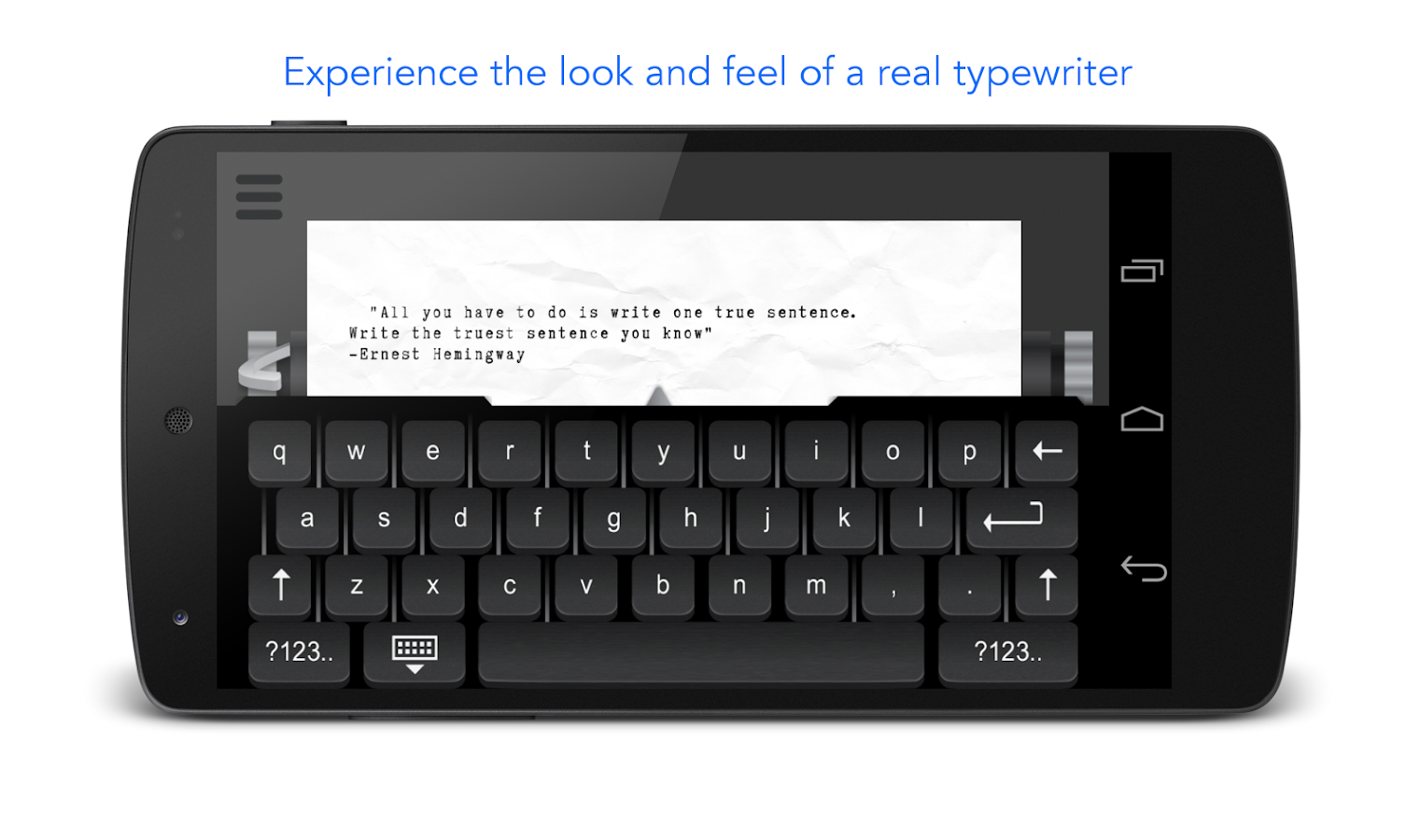
Download Visual Typewriter 1.5 + keygen crack. Review this Software. You may use these HTML tags and attributes: href=' title='>. Sep 18, 2017. Visual Typewriter Keygen. McAfee Internet security 2012 FULL with lifetime license keygen.rar. Visual Typewriter. Keygen is short for Key Generator. Visual Typewriter is a writing software, simulating a classic manual typewriter. ASCII Art Generator is an amazing graphics art to text art solution..
In finance, a foreign exchange option (commonly shortened to just FX option or currency option) is a derivative financial instrument that gives the right but not the obligation to exchange money denominated in one currency into another currency at a pre-agreed exchange rate on a specified date.[1] See Foreign exchange derivative. The foreign exchange options market is the deepest, largest and most liquid market for options of any kind. Most trading is over the counter (OTC) and is lightly regulated, but a fraction is traded on exchanges like the International Securities Exchange, Philadelphia Stock Exchange, or the Chicago Mercantile Exchange for options on futures contracts. The global market for exchange-traded currency options was notionally valued by the Bank for International Settlements at $158.3 trillion in 2005 For example, a GBPUSD contract could give the owner the right to sell?1,000,000 and buy $2,000,000 on December 31. In this case the pre-agreed exchange rate, or strike price, is 2.0000 USD per GBP (or GBP/USD 2.00 as it is typically quoted) and the notional amounts (notionals) are?1,000,000 and $2,000,000. This type of contract is both a call on dollars and a put on sterling, and is typically called a GBPUSD put, as it is a put on the exchange rate; although it could equally be called a USDGBP call.
If the rate is lower than 2.0000 on December 31 (say 1.9000), meaning that the dollar is stronger and the pound is weaker, then the option is exercised, allowing the owner to sell GBP at 2.0000 and immediately buy it back in the spot market at 1.9000, making a profit of (2.0000 GBPUSD? 1.9000 GBPUSD)? 1,000,000 GBP = 100,000 USD in the process. If instead they take the profit in GBP (by selling the USD on the spot market) this amounts to 100,000 / 1.9000 = 52,632 GBP.
Although FX options are more widely used today than ever before, few multinationals act as if they truly understand when and why these instruments can add to shareholder value. To the contrary, much of the time corporates seem to use FX options to paper over accounting problems, or to disguise the true cost of speculative positioning, or sometimes to solve internal control problems. The standard clich? About currency options affirms without elaboration their power to provide a company with upside potential while limiting the downside risk. Options are typically portrayed as a form of financial insurance, no less useful than property and casualty insurance. This glossy rationale masks the reality: if it is insurance then a currency option is akin to buying theft insurance to protect against flood risk. The truth is that the range of truly non-speculative uses for currency options, arising from the normal operations of a company, is quite small.
In reality currency options do provide excellent vehicles for corporates' speculative positioning in the guise of hedging. Corporates would go better if they didn't believe the disguise was real. Let's start with six of the most common myths about the benefits of FX options to the international corporation -- myths that damage shareholder values. Historically, the currency derivative pricing literature and the macroeconomics literature on FX determination have progressed separately. In this Chapter I argue the joint study of these two strands of literature and give an overview of FX option pricing concepts and terminology crucial for this interdisciplinary study. I also explain the three sources of information about market expectations and perception of risk that can be extracted from FX option prices and review empirical methods for extracting option-implied densities of future exchange rates. As an illustration, I conclude the Chapter by investigating time series dynamics of option-implied measures of FX risk vis-a-vis market events and US government policy actions during the period January 2007 to December 2008.
Chapter 2: This Chapter proposes using foreign exchange (FX) options with different strike prices and maturities to capture both FX expectations and risks. We show that exchange rate movements, which are notoriously difficult to model empirically, are well-explained by the term structures of forward premia and options-based measures of FX expectations and risk. Although this finding is to be expected, expectations and risk have been largely ignored in empirical exchange rate modeling. Using daily options data for six major currency pairs, we first show that the cross section options-implied standard deviation, skewness and kurtosis consistently explain not only the conditional mean but also the entire conditional distribution of subsequent currency excess returns for horizons ranging from one week to twelve months. At June 30 and September 30, the value of the portfolio was?1,050,000. Note, however, that the notional amount of Ridgeway's hedging instrument was only?1,000,000.
Therefore, subsequent to the increase in the value of the pound (which is assumed to have occurred on June 30), a portion of Ridgeway's foreign currency exchange risk was not hedged. For the three-month period ending September 30, exchange rates caused the value of the portfolio to decline by $52,500. Of that amount, only $50,000 was offset by changes in the value of the currency put option.
The difference between those amounts ($2,500) represents the exchange rate loss on the unhedged portion of the portfolio (i.e., the 'additional'?50,000 of fair value that arose through increased share prices after entering into the currency hedge). At June 30, the additional?50,000 of stock value had a U.S. Dollar fair value of $45,000. At September 30, using the spot rate of 0.85:1, the fair value of this additional portion of the portfolio declined to $42,500. Ridge way will exclude from its assessment of hedge effectiveness the portion of the fair value of the put option attributable to time value.
That is, Ridgeway will recognize changes in that portion of the put option's fair value in earnings but will not consider those changes to represent ineffectiveness. Aitan Goelman, the CFTC’s Director of Enforcement, stated: “The setting of a benchmark rate is not simply another opportunity for banks to earn a profit. Countless individuals and companies around the world rely on these rates to settle financial contracts, and this reliance is premised on faith in the fundamental integrity of these benchmarks. The market only works if people have confidence that the process of setting these benchmarks is fair, not corrupted by manipulation by some of the biggest banks in the world.” The Commission finalized rules to implement the Dodd-Frank Wall Street Reform and Consumer Protection Act regarding Regulation of Off-Exchange Retail Foreign Exchange Transactions and Intermediaries. The Commission also finalized Conforming Changes to existing Retail Foreign Exchange Regulations in response to the Dodd-Frank Act. Additional information regarding these final rules is provided below, including rules, factsheets, and details of meetings held between CFTC Staff and outside parties.
Given an length of time, a punching at random on a typewriter would type out all of plays. The infinite monkey theorem states that a monkey hitting keys at on a typewriter keyboard for an amount of time will type a given text, such as the complete works of.
In fact the monkey would almost surely type every possible finite text an infinite number of times. However, the that monkeys filling the would type a complete work such as Shakespeare's is so tiny that the chance of it occurring during a period of time hundreds of thousands of orders of magnitude longer than the is extremely low (but technically not zero). In this context, 'almost surely' is a mathematical term with a precise meaning, and the 'monkey' is not an actual monkey, but a for an abstract device that produces an endless of letters and symbols. One of the earliest instances of the use of the 'monkey metaphor' is that of French mathematician in 1913, but the first instance may have been even earlier. Variants of the theorem include multiple and even infinitely many typists, and the target text varies between an entire library and a single sentence.
Traced the history of this idea from 's and 's (On the Nature of the Gods), through and, up to modern statements with their iconic simians and typewriters. In the early 20th century, Borel and used the theorem to illustrate the timescales implicit in the foundations of. Is sometimes misattributed with proposing a variant of the theory in his debates with. In his 1931 book The Mysterious Universe, Eddington's rival attributed the monkey parable to a 'Huxley', presumably meaning. This attribution is incorrect. Today, it is sometimes further reported that Huxley applied the example in a over 's with the Anglican Bishop of Oxford, Samuel Wilberforce, held at a meeting of the at Oxford on 30 June 1860.
This story suffers not only from a lack of evidence, but the fact that in 1860 the typewriter itself had yet to emerge. Despite the original mix-up, monkey-and-typewriter arguments are now common in arguments over evolution.
For example, Doug Powell argues as a that even if a monkey accidentally types the letters of Hamlet, it has failed to produce Hamlet because it lacked the intention to communicate. His parallel implication is that natural laws could not produce the information content in. A more common argument is represented by Reverend, who claims that the genetic mutations necessary to produce a tapeworm from an amoeba are as unlikely as a monkey typing Hamlet's soliloquy, and hence the odds against the evolution of all life are impossible to overcome. Employs the typing monkey concept in his book to demonstrate the ability of to produce biological out of random. In a simulation experiment Dawkins has his produce the Hamlet phrase METHINKS IT IS LIKE A WEASEL, starting from a randomly typed parent, by 'breeding' subsequent generations and always choosing the closest match from progeny that are copies of the parent, with random mutations. The chance of the target phrase appearing in a single step is extremely small, yet Dawkins showed that it could be produced rapidly (in about 40 generations) using cumulative selection of phrases.
The random choices furnish raw material, while cumulative selection imparts information. As Dawkins acknowledges, however, the weasel program is an imperfect analogy for evolution, as 'offspring' phrases were selected 'according to the criterion of resemblance to a distant ideal target.' In contrast, Dawkins affirms, evolution has no long-term plans and does not progress toward some distant goal (such as humans). The weasel program is instead meant to illustrate the difference between cumulative selection, and single-step selection. In terms of the typing monkey analogy, this means that Romeo and Juliet could be produced relatively quickly if placed under the constraints of a nonrandom, Darwinian-type selection because the will tend to preserve in place any letters that happen to match the target text, improving each successive generation of typing monkeys. A different avenue for exploring the analogy between evolution and an unconstrained monkey lies in the problem that the monkey types only one letter at a time, independently of the other letters. Hugh Petrie argues that a more sophisticated setup is required, in his case not for biological evolution but the evolution of ideas: In order to get the proper analogy, we would have to equip the monkey with a more complex typewriter.
It would have to include whole Elizabethan sentences and thoughts. It would have to include Elizabethan beliefs about human action patterns and the causes, Elizabethan morality and science, and linguistic patterns for expressing these. It would probably even have to include an account of the sorts of experiences which shaped Shakespeare's belief structure as a particular example of an Elizabethan. Then, perhaps, we might allow the monkey to play with such a typewriter and produce variants, but the impossibility of obtaining a Shakespearean play is no longer obvious. Solfege Pour Les Nuls Ebookers here. What is varied really does encapsulate a great deal of already-achieved knowledge., while admitting that the classic monkey's task is impossible, finds that there is a worthwhile analogy between written English and the genome in this other sense: both have 'combinatorial, hierarchical structures' that greatly constrain the immense number of combinations at the alphabet level.
Literary theory [ ] argued in 1938 that art cannot be produced by accident, and wrote as a sarcastic aside to his critics.some. Have denied this proposition, pointing out that if a monkey played with a typewriter. He would produce.
The complete text of Shakespeare. Any reader who has nothing to do can amuse himself by calculating how long it would take for the probability to be worth betting on. But the interest of the suggestion lies in the revelation of the mental state of a person who can identify the 'works' of Shakespeare with the series of letters printed on the pages of a book. Took the contrary position, illustrating his point along with Catherine Elgin by the example of Borges' ', What Menard wrote is simply another inscription of the text. Any of us can do the same, as can printing presses and photocopiers. Indeed, we are told, if infinitely many monkeys. One would eventually produce a replica of the text.
That replica, we maintain, would be as much an instance of the work, Don Quixote, as Cervantes' manuscript, Menard's manuscript, and each copy of the book that ever has been or will be printed. In another writing, Goodman elaborates, 'That the monkey may be supposed to have produced his copy randomly makes no difference. It is the same text, and it is open to all the same interpretations.' Dismisses Goodman's argument as. For, the question of the identity of texts leads to a different question, that of author.
If a monkey is capable of typing Hamlet, despite having no intention of meaning and therefore disqualifying itself as an author, then it appears that texts do not require authors. Possible solutions include saying that whoever finds the text and identifies it as Hamlet is the author; or that Shakespeare is the author, the monkey his agent, and the finder merely a user of the text. These solutions have their own difficulties, in that the text appears to have a meaning separate from the other agents: what if the monkey operates before Shakespeare is born, or if Shakespeare is never born, or if no one ever finds the monkey's typescript?
Random document generation [ ] The theorem concerns a which cannot be fully carried out in practice, since it is predicted to require prohibitive amounts of time and resources. Nonetheless, it has inspired efforts in finite random text generation. One computer program run by Dan Oliver of Scottsdale, Arizona, according to an article in, came up with a result on August 4, 2004: After the group had worked for 42,162,500,000 billion billion monkey-years, one of the 'monkeys' typed, ' VALENTINE. Cease toIdor:eFLP0FRjWK78aXzVOwm)-‘;8.t' The first 19 letters of this sequence can be found in 'The Two Gentlemen of Verona'. Other teams have reproduced 18 characters from 'Timon of Athens', 17 from 'Troilus and Cressida', and 16 from 'Richard II'.
A website entitled The Monkey Shakespeare Simulator, launched on July 1, 2003, contained a that simulated a large population of monkeys typing randomly, with the stated intention of seeing how long it takes the virtual monkeys to produce a complete Shakespearean play from beginning to end. For example, it produced this partial line from, reporting that it took '2,737,850 million billion billion billion monkey-years' to reach 24 matching characters: RUMOUR. Open your ears; 9r'5j5&?OWTY Z0d. Due to processing power limitations, the program used a probabilistic model (by using a or RNG) instead of actually generating random text and comparing it to Shakespeare.
When the simulator 'detected a match' (that is, the RNG generated a certain value or a value within a certain range), the simulator simulated the match by generating matched text. More sophisticated methods are used in practice for. If instead of simply generating random characters one restricts the generator to a meaningful vocabulary and conservatively following grammar rules, like using a, then a random document generated this way can even fool some humans (at least on a cursory reading) as shown in the experiments with,, and the. Testing of random-number generators [ ]. Main article: Questions about the statistics describing how often an ideal monkey is to type certain strings translate into; these range from the simple to the 'quite sophisticated'.
Computer-science professors and report that they used to call one such category of tests 'overlapping m- tests' in lectures, since they concern overlapping m-tuples of successive elements in a random sequence. But they found that calling them 'monkey tests' helped to motivate the idea with students. They published a report on the class of tests and their results for various RNGs in 1993.
In popular culture [ ]. Longman Dictionary Of Contemporary English 5th Edition Free Download Torrent here. Main article: The infinite monkey theorem and its associated imagery is considered a popular and proverbial illustration of the mathematics of probability, widely known to the general public because of its transmission through popular culture rather than through formal education. This is helped by the innate humor stemming from the image of literal monkeys rattling away on a set of typewriters, and is a popular visual gag. In episode ',' shows 'a room with a thousand monkeys on a thousand typewriters. Soon they will have written the greatest novel known to man!' In his 1978 radio play,, invoked the theorem to illustrate the power of the 'Infinite Improbability Drive' that powered a spaceship. From Episode 2: ', there's an infinite number of monkeys outside who want to talk to us about this script for they've worked out.'
A quotation attributed to a 1996 speech by Robert Wilensky stated, 'We've heard that a million monkeys at a million keyboards could produce the complete works of Shakespeare; now, thanks to the Internet, we know that is not true.' The enduring, widespread popularity of the theorem was noted in the introduction to a 2001 paper, 'Monkeys, Typewriters and Networks: The Internet in the Light of the Theory of Accidental Excellence' (Hoffmann & Hofmann, 2001). In 2002, an article in said, 'Plenty of people have had fun with the famous notion that an infinite number of monkeys with an infinite number of typewriters and an infinite amount of time could eventually write the works of Shakespeare.' In 2003, the previously mentioned funded experiment involving real monkeys and a computer keyboard received widespread press coverage.
In 2007, the theorem was listed by magazine in a list of eight classic. See also [ ] • •, another thought experiment involving infinity • • •, explains the multiverse in which every possible event will occur infinitely many times • • • • Notes [ ]. • This shows that the probability of typing 'banana' in one of the predefined non-overlapping blocks of six letters tends to 1. In addition the word may appear across two blocks, so the estimate given is conservative.
• The first theorem is proven by a similar if more indirect route in Gut, Allan (2005). Probability: A Graduate Course.
• Using the Hamlet text, there are 132680 alphabetical letters and 199749 characters overall • For any required string of 130,000 letters from the set a-z, the average number of letters that needs to be typed until the string appears is (rounded) 3.4 × 10 183,946, except in the case that all letters of the required string are equal, in which case the value is about 4% more, 3.6 × 10 183,946. In that case failure to have the correct string starting from a particular position reduces with about 4% the probability of a correct string starting from the next position (i.e., for overlapping positions the events of having the correct string are not independent; in this case there is a positive correlation between the two successes, so the chance of success after a failure is smaller than the chance of success in general).
The figure 3.4 × 10 183,946 is derived from n = 26 130000 by taking the logarithm of both sides: log 10( n) = 1300000×log 10(26) = 1, therefore n = 10 0.5352 × 10 183946 = 3.429 × 10 183946. • 26 letters ×2 for capitalisation, 12 for punctuation characters = 64, 199749×log 10(64) = 4.4 × 10 360,783 (this is generous as it assumes capital letters are separate keys, as opposed to a key combination, which makes the problem vastly harder). • There are ~10 80 protons in the observable universe. Assume the monkeys write for 10 38 years (10 20 years is when, 10 38 years is when all but 0.1% of ). Assuming the monkeys type non-stop at a ridiculous 400 (the world record is 216wpm for a single minute), that's about 2000 characters per minute (Shakespeare's average word length is a bit under 5 letters). There are about half a million minutes in a year, this means each monkey types half a billion characters per year. This gives a total of 10 80×10 38×10 9=10 127 letters typed – which is still zero in comparison to 10 360,783.
For a one in a trillion chance, multiply the letters typed by a trillion: 10 127×10 15=10 145. 10 360,783/10 145=10 360,641. • As explained at, the problem can be approximated further. 10 145/log 10(64)=78.9 characters.
• Examples of the theorem being referred to as proverbial include: Why Creativity Is Not like the Proverbial Typing Monkey. Schooler, Sonya Dougal, Psychological Inquiry, Vol. 4 (1999); and The Case of the Midwife Toad (, New York, 1972, page 30): 'Neo-Darwinism does indeed carry the nineteenth-century brand of materialism to its extreme limits—to the proverbial monkey at the typewriter, hitting by pure chance on the proper keys to produce a Shakespeare sonnet.' The latter is sourced from, a collection of historical references to the theorem in various formats.
References [ ].